Dalhousie University’s Linh Tran has won the 2026 Falling Walls Lab Atlantic Canada pitch competition for research aimed at improving diagnostic testing with smaller blood samples.
Tran, a master’s candidate in biomedical engineering, won the competition Monday at Halifax Central Library with a three-minute presentation titled “Breaking the Wall of Sample Volume: Big Diagnostics from Tiny Volume.”
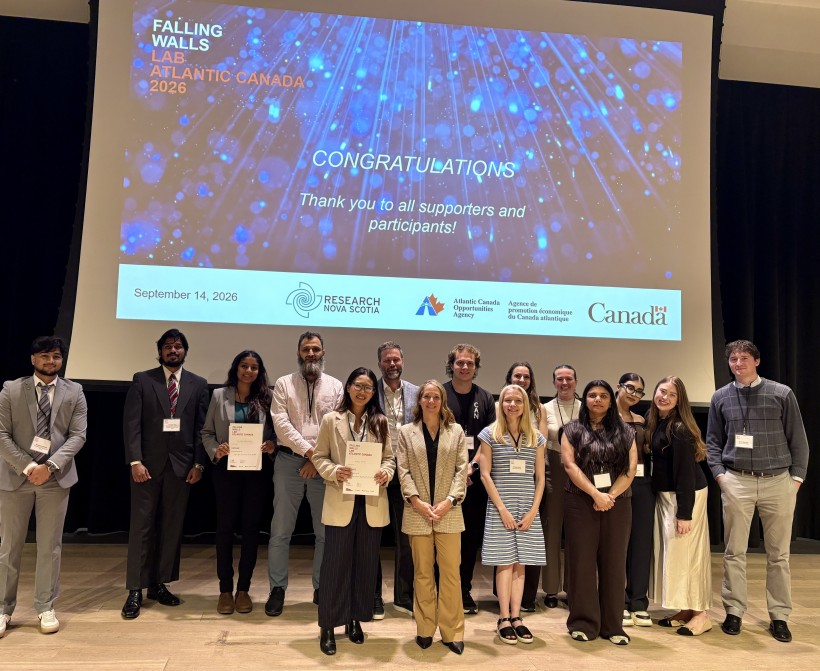
She was one of 14 participants from universities across Atlantic Canada who competed in the event, which was hosted by Research Nova Scotia and supported by the Atlantic Canada Opportunities Agency.
Tran’s research uses biomarker capture and detection to conduct diagnostic tests with about half the blood volume normally required. The approach is intended to reduce the need for repeated blood-sample collection when patients or research subjects cannot provide sufficient volume for conventional testing.
The research could be particularly useful in bloodwork involving infants and older adults, as well as research subjects for whom larger samples are difficult to obtain.
“Winning Falling Walls Lab Atlantic Canada means so much to me because it gives me an opportunity to represent our province and share the work our lab has been so excited about,” Tran said in a statement.
“It’s a simple approach that could change diagnostic testing by pulling more information from a smaller sample, across nearly every area of disease.”
As the Atlantic Canada winner, Tran will represent the region at the Falling Walls Lab Global Finale in Berlin on Nov. 6. The event is part of the Falling Walls Science Summit.
She will compete against 100 winners from Falling Walls Labs around the world in the Emerging Talents category. The competition will select a “Breakthrough Winner,” who will have an opportunity to appear at the Falling Walls Breakthroughs of the Year event alongside leading scientists.
The Halifax competition featured researchers from a range of disciplines. Participants presented their research in three-minute pitches before a jury made up of experts from academia, business and government.
Stefan Leslie, CEO of Research Nova Scotia, said the finalists presented research ideas addressing global challenges.
The second place prize went to Orion Wiersma who aims to use 3D ultrasound to address bottlencks in orthopedic care. He won $500. Third place went to Kavindya Samarakoon, who aims to use grape seeds to treat metabolic disease. She won $250.
The Falling Walls Lab is an international competition designed to give emerging researchers an opportunity to present research and ideas in short presentations.